Project Cargo Is a Planning Problem First
Project cargo moves fail at the planning stage, not the execution stage. The transformer that won't clear a bridge. The pressure vessel permitted for the wrong axle configuration. The multi-piece shipment sequenced in the wrong order and delivered to a site that can't store it. These aren't execution failures — they're planning failures that showed up during execution.
We treat project cargo as an engineering problem before it becomes a logistics problem. Route analysis, equipment selection, permit engineering, weight distribution, and site coordination happen before a quote goes out. For forwarders and EPC contractors with clients behind them, that's not optional — it's the minimum standard.
What Project Cargo Actually Involves
The term gets used loosely. For us, project cargo means freight where at least one of the following is true:
- The load exceeds standard highway dimensions or weight — requiring permits, route surveys, and potentially escorts in multiple states
- The move involves multiple pieces or shipments — where sequencing, timing, and delivery order are part of the logistics plan, not just the freight itself
- The origin or destination is operationally complex — a port terminal with specific outgate requirements, a construction site with crane constraints, a plant with limited access windows
- The cargo has specific handling, rigging, or offloading requirements — that must be communicated to and confirmed by every party in the chain before dispatch
- There is a downstream dependency — a construction timeline, a plant startup, a commissioning window that the freight arrival is tied to
If any of those apply, you need a broker that plans before pricing. Not one that books a carrier and hopes the details work out.
Equipment We Coordinate
Permit Engineering for Multi-State Project Moves
A project move crossing multiple states is not a single permit — it's a permit package for every state in the route, each filed separately, each with its own dimensional thresholds, fee structures, routing restrictions, and processing timelines. Getting this wrong adds days to a move and can result in fines, load holds, and missed site windows.
- Route survey first — bridge clearances, weight limits, overhead utilities, and road surface conditions reviewed before the permit application is filed
- Bridge analysis — for heavy loads approaching bridge weight limits, we coordinate state DOT bridge analysis letters where required before permits are approved
- Permit sequencing — multi-state permits filed and tracked in sequence aligned to a realistic transit schedule, not submitted all at once and hoped for
- Travel restriction management — daylight-only requirements, holiday blackouts, Sunday travel bans, and utility coordination for overhead line lifts all built into the move schedule
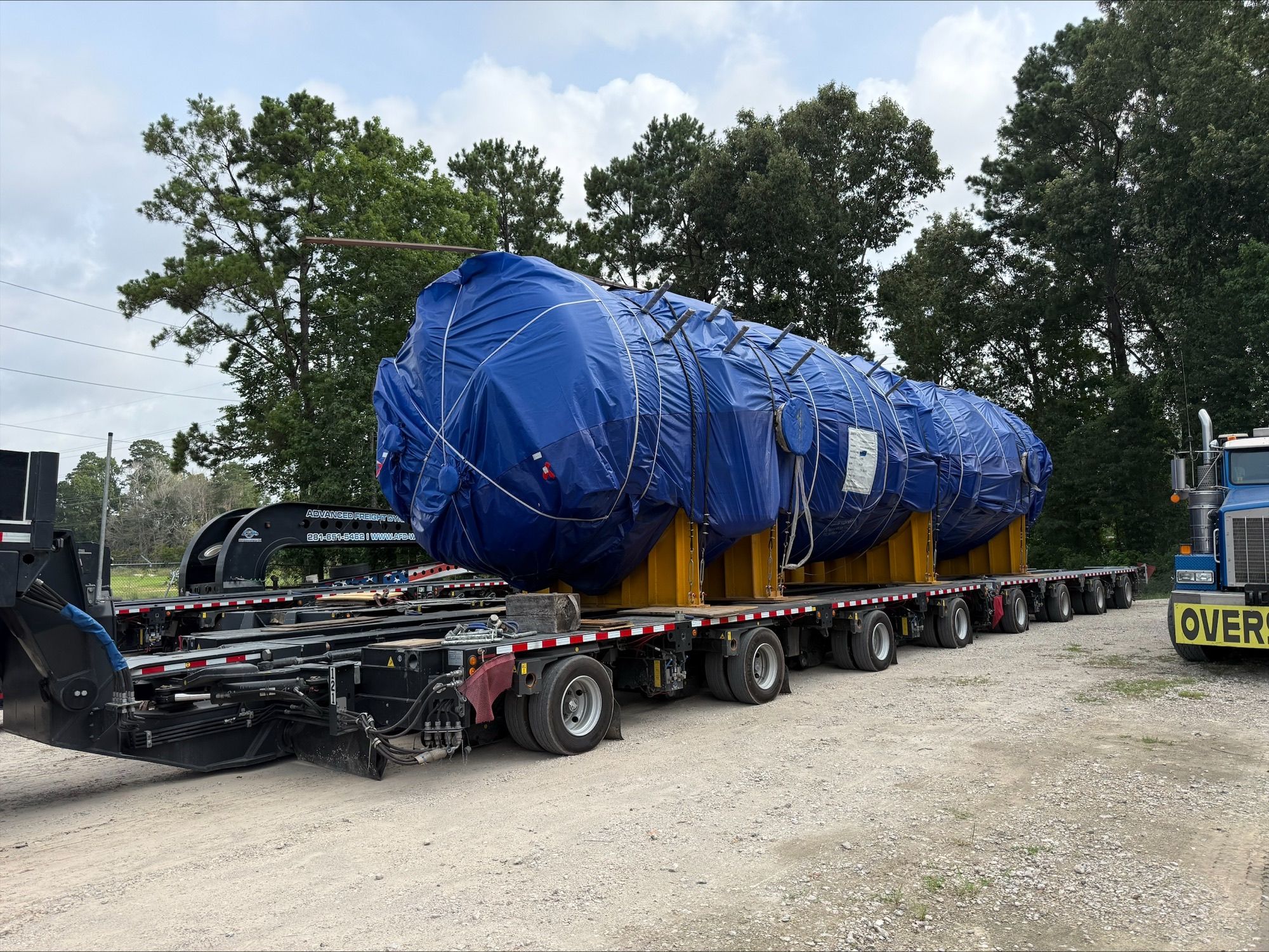
- Superload coordination — superload classifications, engineering-review requirements, and permit lead times vary by state, route, loaded dimensions, gross weight, and axle configuration. The largest moves can take weeks to permit, so we start this process early — as we did for a 223,000-lb evaporator permitted through Texas, New Mexico, Arizona, and California.
Port to Jobsite Moves
Most heavy industrial equipment arrives in the U.S. via vessel. Getting it from the port terminal to the final jobsite is where project cargo brokerage earns its value — or loses it.
Port environments have their own constraints: terminal outgate hours, overheight and overweight handling procedures, and release timing that rarely aligns perfectly with a carrier's schedule. Once cargo is released and ready to move, we take over the inland leg — equipment sourced, permits in hand, and delivery coordinated with the receiving site before the truck departs.
- Gulf Coast — Houston, New Orleans, Mobile, Corpus Christi. The primary U.S. import corridor for heavy industrial and energy project cargo.
- East Coast — Savannah, Charleston, Baltimore, New York/New Jersey, Miami. Atlantic corridor for European, South American, and Caribbean project shipments.
- West Coast — Los Angeles, Long Beach, Seattle, Portland. Major import gateway for Asian-manufactured industrial and capital equipment.
- Inland Waterway — For cargo moving via river barge, we coordinate the truck leg from river terminals and barge offload points to final destination.
Recent Project Cargo Move
For Freight Forwarders
If you're managing the international leg and need a domestic inland partner for the U.S. truck move, we are built for that relationship. Forwarders have specific expectations that most domestic brokers don't understand or don't take seriously.
- You have a client behind you — we understand that your reputation with your client depends on how we execute the domestic leg. We act accordingly.
- Documentation must be clean — permits, BOLs, PODs, and any exception documentation handled correctly and provided promptly. No chasing paperwork after the fact.
- Communication must be proactive — you need to know before your client asks. We provide updates when things are on schedule and immediately when they're not.
- Compliance is not negotiable — oversize permits, weight compliance, and carrier qualification are handled to standard on every load, not depending on how rushed the booking is.
For EPC Contractors
Engineering, procurement, and construction firms move freight tied to project schedules that don't flex. A transformer that misses its delivery window doesn't just delay installation — it delays commissioning, which delays startup, which has a cost that dwarfs the freight invoice.
- Schedule-aware logistics — we understand what the downstream dependency is and plan the move to protect it, not just execute the transport
- Site coordination — arrival timing, crane windows, site access restrictions, and offloading crew coordination communicated and confirmed before dispatch
- Multi-piece sequencing — for projects with multiple large components arriving over time, we coordinate delivery order and site staging to match your construction sequence
- Contingency planning — weather delays, permit holds, and equipment issues happen on complex moves. We identify the contingencies before departure, not after something goes wrong.
Industries We Serve
What to Send Us
The more detail upfront, the better the plan and the more accurate the quote. For project cargo we want:
- Load dimensions — length, width, height of the cargo itself (not the trailer)
- Total load weight and any weight distribution information (center of gravity, lift points)
- Origin and destination with full addresses and any known access constraints
- Timeline — hard delivery deadlines, site availability windows, crane scheduling
- Number of pieces and whether sequenced delivery is required
- Any special handling, rigging, or offloading requirements
- Whether the cargo is coming off a vessel and if so, port, terminal, and expected release date
If you don't have all of this yet, send what you have through the quote form or call us. We can help you identify what's needed before the planning process starts.