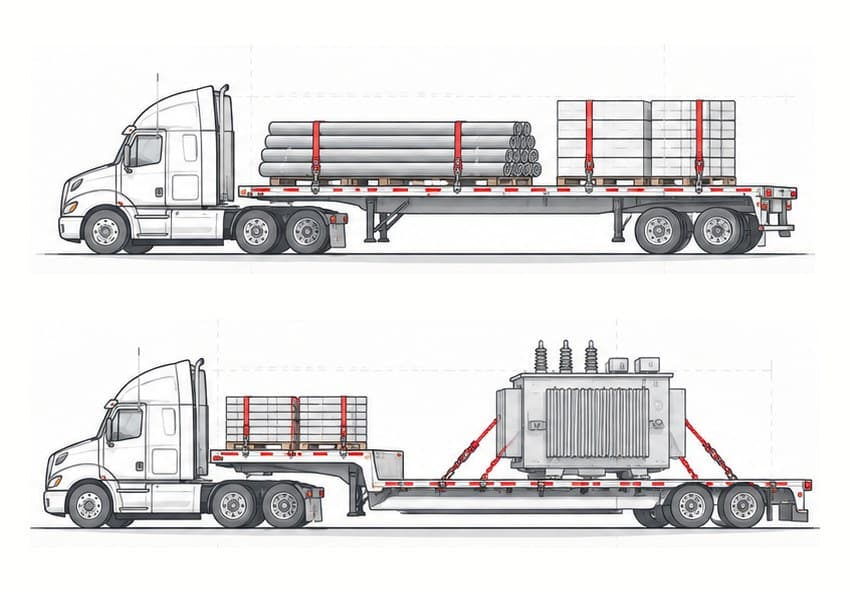
- Flatbed: freight up to about 8′6″ tall. The most common and easiest to book.
- Step deck: freight up to about 10′ tall, and equipment that drives on.
- Bigger than that: double drop, RGN, or permits.
Shippers often ask for “a flatbed” when the load needs a step deck, or book a step deck when a flatbed would have been cheaper and easier to find. The difference comes down to one number: how tall is the freight?
*Under a 13′6″ height limit. All figures are typical and vary by trailer, truck, and axle setup.
Why Height Decides It
Most states east of the Mississippi cap total height at 13′6″ from the road, and many western states allow 14′. Most loads cross at least one 13′6″ state, so that’s the number to plan around.
A flatbed deck sits about 5′ off the ground, leaving about 8′6″ for freight. A step deck’s lower deck sits about 3′6″ off the ground, leaving about 10′. That extra 18 inches is the whole reason step decks exist.
Which One Fits Your Freight
Flatbed is the default. Steel, pipe, lumber, building materials, and machinery under 8′6″ ride on flatbeds every day, and they’re the easiest trucks to find. See our flatbed and open deck service.
Step deck is for freight between 8′6″ and 10′ tall, and for equipment that drives or rolls on, since many carry ramps. Freight on the short upper deck is still limited to about 8′6″. There are fewer step decks on the road, so give a little more lead time.
When Neither One Works
Taller than 10′ moves on a double drop or RGN, up to about 11′6″. Wider than 8′6″ is oversize in every state and needs permits, and the widest loads also need escorts. Heavier than about 48,000 lbs needs more axles and often an overweight permit. That’s heavy haul and oversize territory.
Tarps and Securement
If the freight needs a tarp, say so up front. Tarping takes time and equipment, and most carriers charge for it. Lumber tarps cover tall loads, steel tarps cover low loads like coils and pipe, and smoke tarps protect just the front from exhaust. If it must stay dry but loads from the side, ask about a Conestoga, which has a rolling tarp system.
Every load is chained or strapped under federal securement rules (49 CFR Part 393). If your freight is painted or easily scratched, ask for edge protection.
What to Send for a Fast Quote
- Length, width, and height of the freight itself, and the total weight
- Number of pieces, and whether it’s palletized, bundled, crated, or loose
- Pickup and delivery addresses, hours, and any site restrictions
- How it loads and unloads (forklift, crane, or drive-on), and whether both ends have room for a 70-foot truck
- Whether it needs tarps or edge protection
- Ready date and delivery deadline
Flatbed & Step Deck FAQs
Usually not without a permit. A flatbed deck sits about 5 feet off the ground, so 9 feet of freight puts the load at about 14 feet. That’s over the 13′6″ limit in most eastern states and right at the limit in the West. A step deck handles it easily, because its lower deck is about 18 inches lower.
Often a little, mainly because there are fewer step decks on the road. If your freight fits on a flatbed, a flatbed is usually the better value. If it doesn’t, give a bit more lead time to find a step deck.
It depends on what it is. Lumber, finished steel, machinery, and anything that can’t get wet usually ships tarped. Tell your broker when you request the quote, because tarping adds time and cost and not every truck carries every tarp.